Showing posts with label Yamaha. Show all posts

Yamaha RD350

Overview

Performance has always been a key factor in the Yamaha portfolio from a long period of time. The bikes developed at Yamaha always have something special in them. Decades back, Yamaha was known for its heavily accelerated bikes, which were much ahead of their time. One of them was the Yamaha RD350.

Style & Design

The iconic classic appeal of the RD 350 is an endless era of style, which won't change even after a long period of time. The time it was launched, it was a style icon. A naked racer of its time, it uses a lot of chrome. Chrome rims, chrome mudguards and chrome silencer's were the main features of attention and they are still on their duty.

Instrument Console

The RD 350 was quiet ahead of its time and featured an analogue tachometer, making it feel more like a race bike of the time. Use of chrome was absent on the console, but it has the necessary indications of neutral, high beam and the indicator lights nicely place on it.

Engine & Performance

The RD350 gets a 347cc, 2 stroke, parallel twin cylinder, air-cooled engine. It also features torque induction with twin carburettor. The engine produces 30.5 BHP @ 6750 rpm and 32.3 NM @ 6500 rpm. Being the first twin cylinder sports bike of India, it was a rock star of its time. In the slow era of 80's, it could easily cross the 100 kmph mark in 8 seconds, making it easily up to 130-150 kmph.

Braking & Suspension

The braking was handled by 180 mm drum braking unit, both for the front as well as rear tyre. Achieving such high speeds with drum brakes was the most risky part of the RD 350 as at that time disc brake was considered deadly by misconceptions and old school thoughts in India. The suspension was telescopic forks for the front and swing arm, coil spring with air damping at the rear.


Ride & Comfort

The RD350 provides considerably lower seat height, making it easy to control and not just that, the handle bar positioning has also been kept standard, resulting into a comfortable position for every ride. The large 18 inch tyre size is dominating on every road type, making it an all-rounder by nature.

Shades & Price

The Yamaha RD 350 was available in Silver, Red and Black colors and those chrome fitting were standard on all the options. Back in the 80's, it was priced around INR 30,000 in 1983.

8 Reasons Why Yamaha YZF-R3 is Better than Kawasaki Ninja 300

Infographics image

8 Reasons Why Yamaha YZF-R3 is Better than Kawasaki Ninja 300
The recently launched Yamaha YZF-R3 is the strictest competition the Kawasaki Ninja 300 could have in India. Being so close to each other in terms of values, let’s see where the differences are between these lightweight sport machines.
1) Both being twin cylinder bikes, the R3 gets a bigger 321 cc motor compared to the 296 cc of the Ninja 300, beneficial when the speed exceeds 170 kmph. Higher power-to-weight ratio of 244.9 BHP/ton makes the R3 a better sprinter than the Ninja 300 with only 223.8 BHP/ton. 175.1 NM/ton of torque-to-weight ratio of the R3 clearly outruns the 156.9 NM/ton of the Ninja 300, significantly affecting its capabilities.
2) Getting 2.9 BHP more than the Ninja 300, R3 clearly gets that extra kmph advantage.
3) With 2.6 NM more torque in the R3, the pulling power is highly affected and chasing the Ninja 300 becomes easy for the R3.
4) R3 gets a 20 mm ground clearance advantage, making it more India friendly than the rival.
5) 3 less kilograms on the R3 makes it more quick and responsive when revving at high speeds, giving it a better top speed.
6) 188 kmph is achieved by the Yamaha R3 whereas Ninja 300 limits its top speed to 182 kmph.
7) R3 gets a bigger disc brake measuring 298 mm when compared to the Ninja's 290 mm, facilitating more aggressive riding experience.
8) Even with all these benefits, the Yamaha R3 comes for INR 40,000 less than its closest competitor.
Both the bikes miss on ABS, which is not even provided as optional on a higher variant. Even after a clear winning approach of the R3, the rider's brand following decides whether they would go for the Ninja 300 or the R3.
Fast Facts about 2015 Yamaha YZF-R3
  • 321cc, 2-Cylinder, liquid-cooled, 4-stroke, DOHC, 4-valves
  • Maximum power of 41.4 Bhp @ 10750 rpm
  • Maximum torque of 29.6 Nm @ 9000 rpm
  • Constant Mesh, 6-speed transmission
  • Front hydraulic single disc, Ø 298 mm
  • Rear hydraulic single disc, Ø 220 mm
  • Front telescopic forks | Rear swingarm
  • Wet, Multiple Disc Clutch | Fuel Injection
  • 110/70-17M/C 54H (Tubeless) | 140/70-17M/C 66H (Tubeless)
  • Ex-showroom price tag of INR 3.25 lakhs

Fast Facts about Kawasaki Ninja 300
  • 296cc, 2-Cylinder, 4-stroke, parallel-twin, liquid-cooled
  • Maximum power of 38.5 Bhp @ 11000 rpm
  • Maximum torque of 27 Nm @ 10000 rpm
  • 6-speed transmission
  • 290mm front disc brake
  • 220mm rear disc brake
  • 37mm hydraulic telescopic front forks
  • Uni-Trak® with 5-way adjustable preload rear suspension
  • Ex-showroom price of Kawasaki Ninja 300 is Rs. 3.65 lakh

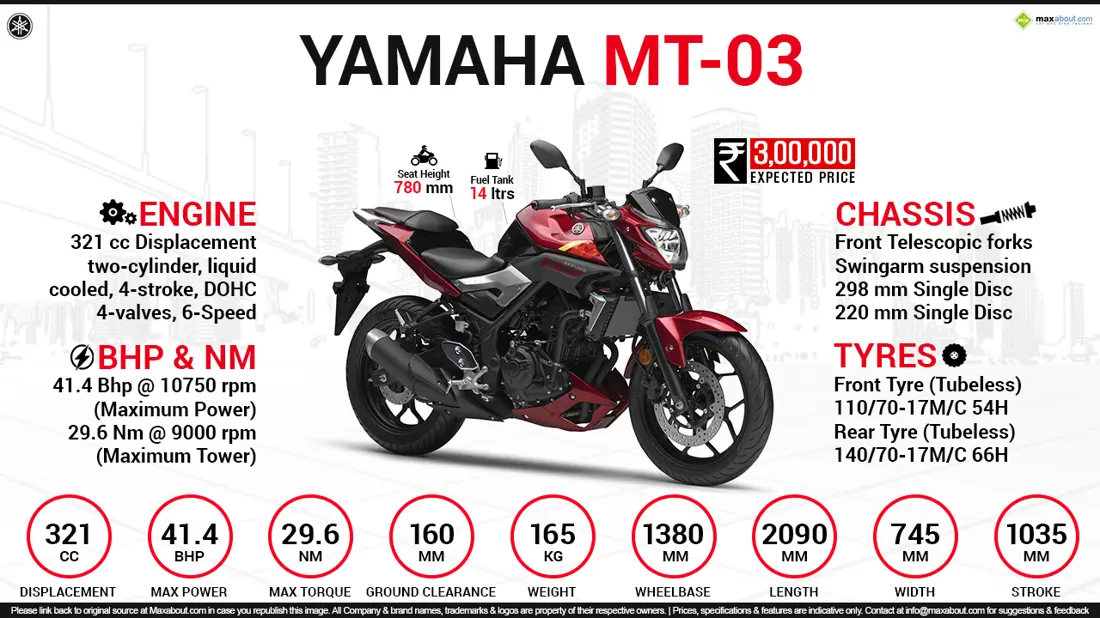
Yamaha MT-03 Review & Pics

Overview

When the taste of naked street sport bikes comes to a rider's tongue, machine like the Yamaha MT-03/MT-320 would be the first name striking to his mind. No doubt the new arrival has many bits to be tested and trusted, the heart under the fuel tank comes from a very prestigious family. The R3's engine has been used for the bike, with its body components and styling nearly matching the MT-25, making it a true naked brother of the R3 as MT-25 was for R25
Yamaha MT-03 Infographic

Design and Style

The design of the bike has been seen in the patented images, pointing directly to a non-faired R3, whose rear is 100 percent the same as the race machine. The front gets a street fighter design, making the bike a muscular and intelligent choice when not willing for the R3. The bike comes with an FZ like headlight and front view, making them true cousins from the Yamaha street bike family.

Brakes and Suspension

The MT-320 will get the same brakes as its race sibling. The front comes with a 298 mm disc brake whereas the rear has a 220 mm unit. ABS is not there, like its faired brother YZF-R3. The suspension is telescopic for the front and monoshock for the rear.

Expected Ex-showroom Price

MT-03 will be available in 3 shades: - Red Metallic, Black Metallic & Matt Silver and the bike is expected to be available in a single non-ABS variant. The price is expected to stay close to INR 3,00,000 and MT-03 is expected to be launched in India at 2016 Auto Expo.

Yamaha VMAX Review

Quick Facts

8 Things You Need to Know about the 2014 Yamaha VMAX

2014 Yamaha VMAX Infographic
GENERAL INFORMATION
Note Above mentioned price of Yamaha VMAX is ex-showroom (Delhi). Price may vary as per applicable state taxes/octroi etc. Please collect exact price details from your nearest Yamaha authorized dealer.
Bike Category (cc) 1500cc-2000cc
Highlights (Key Features) Super powerful 1679cc V4 engine, low-profile aluminium frame, big muscular design, hearty exhaust growl, great performance through RPM range, centre mass for better handling
Type Cruiser
Status Available
Official Tagline Born with Muscles
Shades/Colors Black
Warranty For 2 years or 30000 kms from the date of purchase (whichever is earlier)
Frame/Chassis Aluminium Diamond Shaped
ENGINE, POWER & TORQUE
Displacement 1679 cc
Maximum Power 197.3 Bhp @ 9000 rpm
Maximum Torque 166.8 Nm @ 6500 rpm
Engine Description Liquid cooled, 4-stroke, DOHC, 4-valve, V-type 4-cylinder
Cooling Liquid Cooling
Fuel System Fuel injection
Ignition T.C.I
Lubrication Wet sump
Compression Ratio 11.3:1
Bore 90 mm
Stroke 66 mm
Number of Cylinders 4
TRANSMISSION
Gearbox 5 Speed Constant mesh
Clutch Wet, multiple-disc
Gear Ratios 1st gear=2.375, 2nd gear= 1.81, 3rd gear= 1.4, 4th gear= 1.115, 5th gear = 0.935
Primary Reduction Ratio 1.509
Secondary Reduction Ratio 3.082
Final transmission Shaft drive
BRAKES
Front Brake Dual Hydraulic disc Ø 320 mm
Rear Brake Single Hydraulic disc brake Ø 298 mm
SUSPENSION
Front Suspension Telescopic Forks, 52mm
Rear Suspension Swing Arm - Link Type Suspension
WHEELS & TYRES
Front Tyre 120/70 R18M/C (59V)
Rear Tyre 200/50 R18M/C (76V)
Wheel Type Alloys
Tubeless Tyres
Alloy Wheels
BATTERY
Battery Type Maintenance Free 
DIMENSIONS, WEIGHT & CAPACITIES
Overall Length 2395 mm
Overall Width 820 mm
Overall Height 1190 mm
Ground Clearance 140 mm
Seat Height 775 mm
Wheelbase 1700 mm
Kerb/Wet Weight 310 kg
Fuel Tank Capacity 15 litres
Oil tank capacity 5.9 litres
PERFORMANCE & MILEAGE
Mileage (City, approx.) 7 kmpl
Mileage (Highway, approx.) 11 kmpl
Mileage (Combined, approx.) 8 kmpl
INSTRUMENT CONSOLE
Speedometer Digital
Tachometer Analogue
Trip Meter Digital-2
Fuel Gauge Digital
COMFORT & CONVENIENCE
Electric Start
Pillion Footrest
Pass Light
Pillion Backrest
Step-up Seat/Split Seat
OTHER SPECIFICATIONS
Caster Angle 31°
Trail 148

Suzuki Gixxer SF vs Bajaj Pulsar AS150 vs Yamaha Fazer FI Version 2.0

The year 2015 saw the launch of two new touring bikes in India, the Suzuki Gixxer SF and the Bajaj Pulsar AS150, to take on the already established Yamaha Fazer. The Fazer itself was updated less than a year ago wherein, it got styling updates and Yamaha bestowed it with fuel injection technology as well. When looking for a bike in the 80,000-90,000 price bracket, the Suzuki Gixxer SF, Yamaha Fazer FI Ver 2.0 and the Bajaj Pulsar AS150 are likely to make it to the list of choices of a prospective buyer. We will compare these three bikes on various parameters to ease your decision-making process in our Suzuki Gixxer SF vs Bajaj Pulsar AS150 vs Yamaha Fazer FI Version 2.0 comparison.
suzuki-gixxer-sf-vs-pulsar-as150-vs-yamaha-fazer-fi

Design

All three bikes have been derived from naked bikes, the Gixxer SF from the Gixxer, the Pulsar AS150 from the Pulsar NS series and the Fazer from the FZ. Out of these, only the Gixxer SF gets a full front fairing and looks the sportiest of the lot. However, the riding position is pretty upright which means it is well suited for daily city commute. The bike looks very striking especially in the MotoGP inspired blue and white livery and also thanks to a slight hint of the Hayabusa around the headlamp area. The Bajaj Pulsar AS200 looks more of a touring bike than the Gixxer with its elaborate front fairing and large wind deflector. It gets a projector headlamp setup integrated very well into the nicely sculpted front end. The front of the Fazer Version 2.0 gets only very subtle changes as compared to earlier version making it a very familiar face on our roads. Although it is a very good looking bike, it does not feel as fresh as the other two. Looks are subjective and it is entirely up to the buyer to decided which of these three bikes is the best in terms of appearance.

Features

The Gixxer SF and the Yamaha Fazer FI V 2.0 get a fully digital read out whereas, the Pulsar AS150 gets an analogue tachometer in combination with a digital speedo. Otherwise, all three bikes are similarly equipped and there are not significant features that set these three apart.


Specs

Suzuki Gixxer SFBajaj Pulsar AS150Yamaha Fazer FI Version 2.0
Engine Displacement155cc149.5cc149cc
Power14.59 bhp @ 8000 rpm17 bhp @ 9500 rpm12.92 bhp @ 8000 rpm
Torque14 Nm @ 6000 rpm13 Nm @ 7000 rpm12.8 Nm @ 6000 rpm
Transmission5-speed6-speed5-speed
Mileage47 kmpl45 kmpl53 kmpl
Top Speed 127 kmph110 kmph106 kmph

Also See – Best Bikes in India Under 1.5 Lakhs
The Pulsar AS150 is the most powerful bike in this comparison by a clear margin. The Gixxer SF hold a slight edge over the rest in terms of torque. When it comes to fuel efficiency the Yamaha Fazer FI Version 2.0 is the clear winner. In daily city commute, it is highly unlikely that these differences will be noticeable.
2014 Yamaha Fazer FI Version 2.0 Black Hawk Paint
Yamaha Fazer FI Version 2.0 the most fuel efficient
The Bajaj Pulsar AS150 is the most powerful. The Yamaha Fazer FI Ver 20 the most fuel-efficient.

Price

Ex-showroom, DelhiSuzuki Gixxer SFBajaj Pulsar AS150Yamaha Fazer FI V 2.0
StandardINR 83,439INR 79,000INR 86,805
The Gixxer SF with the Special Edition MotoGP Livery costs INR 94,238. The Pulsar AS150 and the Yamaha Fazer FI are not available in any other variants.
suzuki-gixxer-sf
Suzuki Gixxer SF Special MotoGP Edition Costs INR 94,238


The Bajaj Pulsar AS150 is the cheapest motorcycle of the lot.

Verdict

The Yamaha Fazer FI Ver 2.0 excels in almost all departments and does not give much of a reason to complain. However, when compared with the earlier model prices have seen a huge jump thanks to the introduction of fuel injection making it the most expensive bike of the lot. The Suzuki Gixxer SF is a very accomplished bike and looks striking, especially in the MotoGP livery. The only drawback is Suzuki’s service network which is not as extensive as its rivals. Our pick here would be the Bajaj Pulsar not only because it is the cheapest, but also because the cost of ownership is very low as the spare parts are comparatively very cheap and the dealership network is very extensive.

Yamaha XSR700

The XSR700 takes the best of design from Yamaha’s history in homage to the past but is very much the motorcycle of tomorrow.


Features See full specifications
Displacement 689 cc
Maximum Power 73.8 BHP @ 9,000 rpm
Maximum Torque 68.0 NM @ 6,500 rpm
Gearbox Constant Mesh, 6-speed
Seat Height 815 mm
Ground Clearance 140 mm
Kerb/Wet Weight 186 kg
Fuel Tank Capacity 14 litres
Mileage (Certified)  23.1 kmpl  

Yamaha YZF-R3 Review

Yamaha R3 Infographic 

Overview

Yamaha Corporation is a world famous Japanese multinational corporation and conglomerate which has a very wide range of products and services in its list and mainly deals in motorcycles, musical instruments, power sports equipment and electronics. It was founded by Torakusu Yamaha in 1887 as a reed organ and piano manufacturing company with the name of Nippon Gakki Company, Limited which was incorporated just a year later in 1897. It has its headquarters in Hamamatsu, Shizuoka, Japan. Yamaha YZF-R3 is expected to be launched in India by August, 2015 (according to a report by BBC TopGear). Let's check out what Yamaha will be going to offer with this stunning sports bike.

Design and Style

Yamaha YZF-R3
The Yamaha R3 is a light-weight A2-licence category supersport bike that turns heads of masses. It is developed using the pure R-series DNA that retains its identity. While the slim and light chassis with agile, sporty handling makes it a perfect racer. Moreover, the aggressive R-series dual headlight and full fairing makes it an eye catcher almost everywhere. The edgy design of the fuel tank carries forward the R-series language and subtle knee recess. The aerodynamic bodywork with mass-forward image looks appealing. More or less the bike resembles to the elder R25 but at the same time shows it own presence too. It uses the tubular diamond frame that offers easy to use ergonomics. A multi-fold wraparound full fairing gives the YZF-R3 a muscular profile. The bike offers a comfortable riding position and the clip-on handlebars delivers a sporty racer styling. Overall, the Yamaha YZF-R3 is quite impressive and pleasant bike with great styling.

Instrument Panel

Yamaha YZF-R3 comes fitted with a digital-analogue instrument console that looks trendy. The panel features a digital speedometer, dual trip meter, fuel-gauge and odometer. It also has an analogue tachometer along with a white colored needle that enhances its look.

Dimensions and Fuel tank capacity

Yamaha R3 has got a length of 2090 mm, width of 720 mm and a height of 1135 mm as its dimension figures. It weighs around 169 Kgs. The bike features a chunky fuel tank with a capacity of 14-litres along with an oil tank capacity of 2.4-litres.

Engine and Transmission

Yamaha YZF-R3 is powered by a 321cc, liquid cooled, smooth and strong engine which kicks out a maximum power of 41.4 Bhp made at 10750 rpm and a maximum torque of 29.6 Nm made at 9000 rpm. This 2-cylinder, 4-valves, 4-stroke, DOHC engine is mated to a six speed constant mesh manual transmission and a wet, multiple disc clutch system. It has a bore and stroke of 60 and 44.1 respectively. It uses the Wet sump lubrication system, fuel injection type carburettor, electric starter system and TCI ignition system.

Brakes and Suspension

The sporty and comfortable suspension with Telescopic forks at the front and Swingarm at the back makes it a strong performer on road. It has a 130 mm front wheel travel and 125 mm rear wheel travel. The 298 mm Hydraulic single disc brakes at the front and 220 mm Hydraulic single disc brakes at the back are there to handle the braking duties.The ABS fitted as standard equipment, ready for everyday use, city or highway.

Ride and Handling

The bike has a minimum ground clearance of 160 mm and an extended wheelbase of 1380 mm. These two make the bike stable around edges and city corners. There is a great fun to ride this amazing supersports motorcycle.

Shades and Expected Price

The Yamaha R3 will be available in three attractive shades: Race Blu, Midnight Black and Rapid Red. The expected price of this bike is INR 2.75-3.00 lakhs (ex-showroom, Delhi) may vary.

Yamaha YZF-R3 - Lightweight Supersport for Everyday Use


Yamaha Xenter 125 - The beauty of getting there early

Infographics image


Quick Facts about Yamaha Xenter 125
  • Engine type - Single cylinder, liquid-cooled, 4-stroke, SOHC, 4-valves
  • Displacement - 125cc
  • Bore x stroke - 52.0 mm x 58.7 mm
  • Compression ratio - 11:1
  • Maximum power - 12.33 BHP @ 7500 rpm
  • Maximum Torque - 11.9 NM @ 7250 rpm
  • Lubrication system - Wet sump
  • Fuel system - Fuel Injection
  • Ignition system - TCI
  • Starter system - Electric
  • Transmission system - V-Belt Automatic
  • Front suspension system - Telescopic fork
  • Front travel - 100 mm
  • Rear suspension system - Swing arm
  • Rear Travel - 92 mm
  • Front brake - Hydraulic single disc, Ø 267 mm
  • Rear brake - Drum, Ø 150 mm
  • Front tyre - 100/80-16
  • Rear tyre - 120/80-16
Copyright © 2014 teqnew